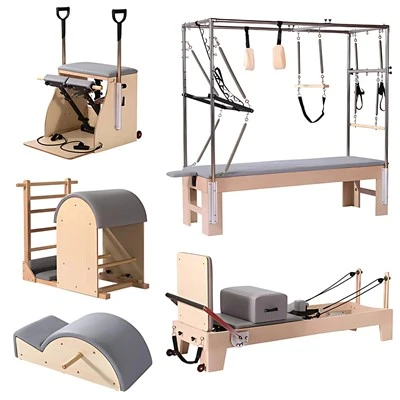
Driven by rising health awareness among the public and the rapid expansion of the mid-to-high-end fitness market, China's Pilates reformer industry has demonstrated steady growth. Although specific market size figures for Pilates reformers in China are not separately disclosed in public data, one can reasonably infer the market's growth potential and structure by analyzing the global Pilates equipment market alongside the overall development of China's Pilates industry. In 2024, the total market size of China's Pilates-related industry reached approximately RMB 8.67 billion-a year-on-year increase of 14.3%. As a core piece of training equipment, the Pilates reformer has seen rising penetration across professional studios, high-end gyms, and among home users. Industry statistics indicate that total sales volume for Pilates reformers in China reached approximately 128,000 units in 2024, up 14.3% from 112,000 units in 2023, reflecting strong end-user demand. Regarding pricing, mainstream Pilates reformers generally range from RMB 8,000 to RMB 25,000 per unit. Domestic mid-to-high-end brands-such as the "PilatesPro" series from Shuhua Sports-are priced around RMB 12,000, whereas comparable products from imported brands like Balanced Body and Stott Pilates typically exceed RMB 20,000, with some customized models reaching over RMB 35,000, creating a distinct market stratification.
Geographically, Tier-1 cities remain the core market for Pilates reformer consumption; Beijing, Shanghai, Guangzhou, and Shenzhen collectively account for 58.6% of national sales. Shanghai leads the market with a 19.3% share, a position driven by a concentration of high-net-worth individuals and a mature boutique fitness sector. Growth in "New Tier-1" cities has been particularly notable; cities such as Chengdu, Hangzhou, and Nanjing all recorded year-on-year sales growth exceeding 18% in 2024, highlighting the expansion potential within these emerging markets. In terms of sales channels, offline specialized fitness equipment distributors remain dominant, accounting for 67.4% of the market; however, sales via e-commerce platforms are growing more rapidly. In 2024, sales of Pilates reformers on JD.com and Tmall rose by 23.1% year-on-year, increasing their share of total sales volume to 29.8%. Some companies have achieved targeted conversions through livestreaming e-commerce and private traffic operations; for instance, during a dedicated fitness equipment livestream on Douyin, Shuhua Sports sold over 1,200 Pilates reformers in a single session, demonstrating the monetization potential of these emerging channels.