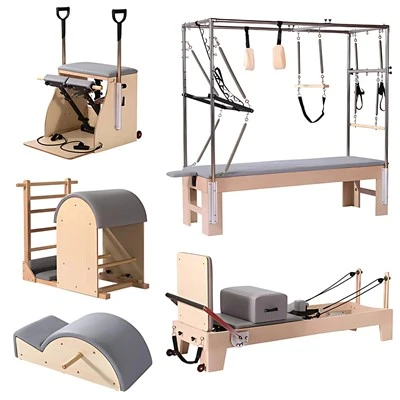

Different brands of reformers may feature subtle functional differences. When purchasing a reformer, it is important to select a certified, high-quality product.
As professional training equipment, Pilates reformers have increasingly found their way into home fitness settings in recent years. Products vary significantly in terms of materials, structure, and functional design-factors that directly impact training stability, durability, and the overall user experience. Based on market data from June 2026, mainstream products generally fall into three categories: fixed solid-wood reformers, full-rail aluminum alloy reformers, and foldable commercial-grade reformers. Each type offers distinct advantages regarding load-bearing capacity, ease of storage, resistance systems, and target demographics; users should select a model based on their available space, training goals, and budget.
Materials and Structure: The Foundation of Stability
The materials used in a reformer directly determine its stability and lifespan. Wooden models typically utilize oak, maple, or beech, offering excellent load-bearing capabilities and a natural aesthetic-ideal for users who prioritize long-term use and seamless home integration. For instance, a fixed reformer made from North American FSC-certified oak-featuring a solid 3.8cm-thick frame, a load capacity exceeding 200kg, and whisper-quiet, wobble-free operation-is widely favored by postpartum recovery specialists and high-end home users. Aluminum alloy frames are characterized by their lightweight nature and corrosion resistance; aerospace-grade 6061-T6 aluminum, treated with an anodized finish, offers a tested lifespan of over 10 years and a static load capacity of up to 300kg. Steel structures are commonly found in commercial-grade products; featuring tube wall thicknesses of 1.5mm or greater and eco-friendly electrostatic powder coating, they balance structural strength with rust resistance. Different materials suit different use cases: solid wood is ideal for permanent placement in homes or studios; aluminum alloy balances portability and strength, making it suitable for users in smaller homes who refuse to compromise on performance; and steel is more common in high-traffic environments like commercial gyms.
Resistance Systems: Springs vs. Latex vs. Smart Adjustment
The resistance system is the foundation that enables the reformer's diverse training capabilities. Traditional spring systems utilize high-carbon manganese steel, offering a rebound rate of up to 98% and maintaining tension well over long-term use. Standard configurations typically include 4–5 springs of varying tensions, allowing for fine-tuned resistance through different combinations-ideal for applications requiring precise load control, such as postpartum recovery and posture correction. Some home-use models substitute springs with latex tubing, offering a softer feel and quieter operation, making them better suited for beginners or noise-sensitive users. Advanced models may feature a hybrid design combining latex tubing and springs, enabling users to switch resistance modes based on their training stage. High-end models incorporate smart adjustment technology, using buttons to control electromagnetic resistance across seven levels; this eliminates the need to manually attach or detach springs, thereby enhancing ease of use. These resistance systems cater to different training philosophies: mechanical springs emphasize tactile feedback and progressive loading, whereas smart systems prioritize ease of use and data tracking. Users should make their choice based on their preferences regarding resistance precision, operational complexity, and budget.
Rail and Carriage Systems: The Key to Movement Fluidity
The smoothness of the carriage system and the design of the rails are critical factors influencing the training experience. High-quality products utilize precision bearings or composite plastic wheels to ensure a smooth glide, free from stuttering or harsh noise. Some premium models feature a "full-track" design that supports not only linear forward-and-backward movement but also vertical lifting and incline adjustments via a three-axis linkage, accommodating a wider range of movement patterns. For instance, user reviews of a unibody, aerospace-grade aluminum alloy model highlight that "the rails and frame are CNC-milled for a finish as smooth as ice," while features like laser-etched angle markings and magnetic locking clips ensure precise, stable angle adjustments. In contrast, entry-level models often offer only basic sliding functionality with shorter rail travel, making it easy to hit the end of the track during exercises like single-leg extensions. Rail material also impacts durability: industrial-grade stainless steel rails offer superior wear and corrosion resistance, whereas standard painted steel tubes may develop wear-related noise over time. Ultimately, the quality of the carriage system directly determines whether a user can focus fully on muscle control and breathing rhythm without distraction.