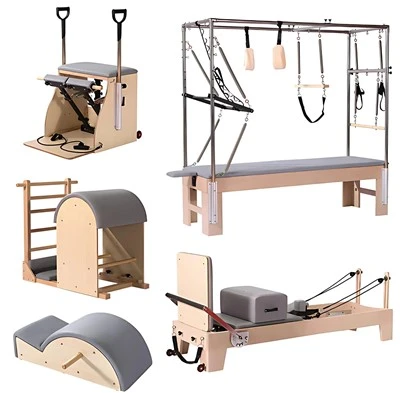
Equipment Inspection: Before training, verify that spring hooks are secure, guide rails move smoothly without sticking or looseness, and shoulder rests/footbars are firmly positioned. Never adjust resistance while springs are under tension.
Resistance Selection: Beginners should start with 1–2 light springs (approx. 5–10 kg), prioritizing lighter loads to avoid excessive resistance that could lead to compensatory movements or lumbar spine compression.
Movement Control: Maintain a slow, steady pace throughout; avoid explosive movements or swinging driven by momentum. Movement of the carriage requires precise control by the core muscles; a speed of ≤10 cm/s is recommended.
Breathing Coordination: Strictly follow the "inhale through the nose, exhale through the mouth" pattern-exhale during exertion (pushing/resisting) and inhale during the return phase. Do not hold your breath at any point to prevent blood pressure fluctuations.
Body Alignment: Maintain a neutral spine and pelvic stability; avoid excessive twisting, hyperextension, or spinal compression. Limit the range of motion to what is pain-free and controllable.