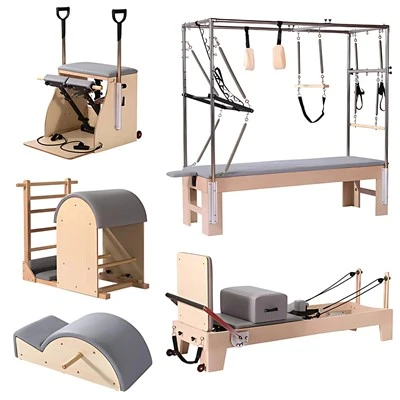

The Reformer is an excellent piece of Pilates equipment. It combines mat-based Pilates movements with postural training to build full-body strength. While strengthening deep stabilizing muscle groups, the Reformer also engages major muscle groups; this builds strength, boosts metabolism, and burns fat, effectively improving posture and sculpting the physique.
Supine Leg Press
Lie on your back on the carriage. Lengthen your cervical spine and align your shoulder blades and pelvis in a neutral position (1a). Place your hands palms-down at your sides; maintain a natural curve in your back-do not arch it excessively or press it completely flat against the carriage. Bend your knees and place your heels on the footbar, keeping your knees and ankles touching and your toes flexed back. Inhale to prepare; exhale to extend your legs straight without locking the knees (1b); inhale to return to the starting position. Repeat 15 times. Maximum resistance: 3 springs.
This is an excellent exercise for the legs, glutes, and torso. Ensure the movement is smooth and controlled.
Leg Extension with External Rotation
Assume the starting position from Exercise 1. Place your heels together and toes apart on the footbar . Rotate your knees and hips outward, but do not over-rotate; use your inner thigh muscles to control the movement. Inhale deeply and engage your upper abdominal stabilizers using 30% of your maximum effort. Exhale to extend your legs in a controlled manner without locking the knees; inhale to return to the starting position. Repeat 15 times. Maximum resistance: 3 springs. This exercise targets the calves and glutes.
Supine Leg Press (Wide Stance)
Lie on your back on the carriage. Place your feet naturally apart on the footbar with your heels pressing against it; rotate your feet, knees, and hips outward (3a). Maintain control over your legs-do not let them go limp-and ensure the outward rotation of your hips stays within your comfortable range of motion. Maintain a neutral spine and align your ribs and shoulder blades. Inhale to prepare; exhale and extend your legs, but do not lock your knees (3b). Repeat 15 times using a maximum load of three springs. Remember to engage the stabilizing muscles of your torso before performing the movement. Since contracting the pelvic floor muscles helps stabilize the pelvis, it is recommended that you engage them at 30% of your maximum effort during the forward and backward movements.
This exercise also targets the legs and glutes.
Strap Pull-Down
Lie on your back with your feet on the footbar and grasp the strap handles. Lift your shoulders slightly off the carriage and extend your arms straight up toward the ceiling. Maintain a stable lumbar spine and pelvis, then lift your legs to a horizontal position with your knees bent at 90 degrees and toes pointed (4a).
Engage your core muscles and align your shoulder blades. Inhale to prepare; exhale and pull the straps down toward your legs (4b) without lifting your head. Repeat 15 times using medium spring tension.
This movement targets the deep abdominal muscles, back, and arms. Throughout the exercise, ensure your shoulder blades remain flat against the carriage and do not shrug forward, as this can place excessive strain on the neck.